
Reviewed · CYCLING TOURS
Budapes Grand Sightseeing Bike Tour
This bike loop gives Budapest your bearings fast. I like the big, photo-ready Danube views you get without waiting in line, and I like the way the guide turns landmarks into clear stories as you ride. My one caution: there’s a short hilly climb in the Castle District, so plan for comfort with an e-bike if that matters to you.
You’ll pedal from the riverfront promenade to major sights across Pest and Buda, with quick stops that work even if you only have a half day. The pace is designed for real sightseeing in about 3 hours, not for turning your day into a marathon.
In This Review
- Key points to notice before you ride
- Why a bike tour works especially well in Budapest
- Price and what you get for about $45.66
- Meeting at Semmelweis u. 14, then rolling into the Duna Corso
- Stop at Erzsébet Bridge: a river-crossing with a history lesson
- Castle District: the short hill, the big payoff
- Margaret Island: the green lung reset in the middle of the ride
- Hungarian Parliament Building: neo-Gothic, Danube reflections, and crown jewels
- Liberty Square: twentieth-century Hungary, explained on the ground
- St. Stephen’s Basilica (Szent István Bazilika): the mummified hand stop
- Optional ride: Andrássy Avenue and the House of Terror
- Optional stop at Heroes’ Square, then a breather in City Park
- What to wear, bike choice, and comfort tips for the Castle climb
- Getting the most out of a 3-hour loop on your first visit
- Who this tour suits best, and who might want a different plan
- How the small group feel can change your experience
- Should you book this Budapest Grand Sightseeing Bike Tour?
- FAQ
- How long is the Budapes Grand Sightseeing Bike Tour?
- What does the tour cost?
- Is the tour offered in English?
- Where is the meeting point and where do you end?
- What’s included with the tour price?
- How many people are in each group?
- Is there an age requirement?
- Is the tour suitable for people with back or knee problems?
- Does the tour run in bad weather?
Key points to notice before you ride
- Danube waterfront photos on the move: Duna Corso views, plus bridge-and-river angles you just cannot get from the sidewalk.
- Only one real hill, for a short stretch: Castle District is the main climb, and e-bikes make it easier.
- World-famous landmarks, but with context: Parliament, St. Stephen’s Basilica, Liberty Square, and more, explained in plain language.
- A small group feel: maximum 10 travelers, so you’re not lost in a crowd.
- Optional add-ons if you have energy: Andrássy Avenue and Heroes’ Square can extend the tour’s payoff.
- Weather-ready tour style: it runs in all conditions, so dress smart.
More of Budapest rolled along the embankment:
- Budapest: Grand Sightseeing Bike Tour
★ 4.8 · 984 reviews - Budapest Highlights Bike Tour
★ 5.0 · 770 reviews - Budapest: Guided City Discovery Bike Tour
★ 4.7 · 702 reviews
Why a bike tour works especially well in Budapest
Budapest is a city of views. From the river, from the bridges, and from higher ground in Buda, the good stuff stacks up fast. A bike tour is a smart way to do that because you keep moving, and the stops stay short and useful.
This tour is built around quick, high-impact windows. You do not spend your limited time stuck on one corner, and you still get guide-led context for each place. It is also small-group, so questions actually make it into the conversation.
If you like seeing a lot without feeling rushed, this is the sweet spot.
Price and what you get for about $45.66
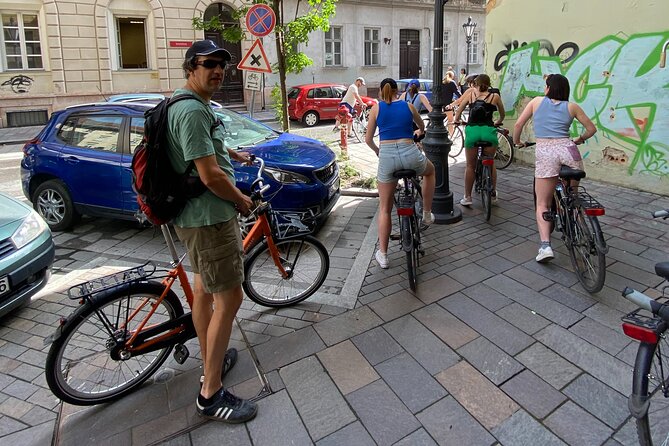
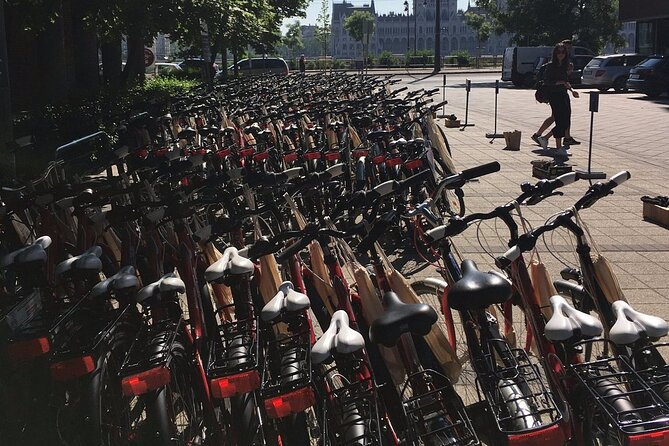
At $45.66 per person for roughly 3 hours, the value comes from what’s included: bicycle use, bottled water, a live guide, and a helmet. You also start with a mobile ticket, which is convenient for check-in.
What you are really paying for is guide time plus logistics. Instead of planning routes between viewpoints yourself, you get a curated loop that hits major landmarks across both sides of the city. For many first-timers, that alone is worth it, because Budapest is spread out and visibility is the whole game.
One more plus: there are no paid admissions added here at the stops, since the tour marks admissions as free at each listed sight. That helps keep the day predictable.
Meeting at Semmelweis u. 14, then rolling into the Duna Corso
You meet at Budapest, Semmelweis u. 14, 1052, and you bike back to the same place at the end. The meeting point is near public transportation, which is handy if you are mixing this with other plans.
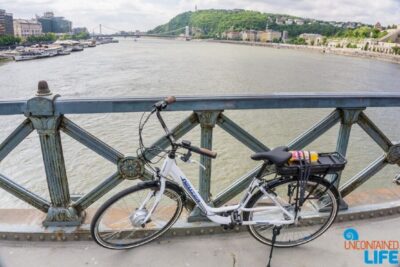
After you gear up, your first segment starts along Duna Corso, one of Budapest’s iconic Danube promenades. This is a great start because the views instantly confirm the shape of the city: Buda on one side, Pest stretching out on the other, and the river acting like the layout line.
Your guide will point out landmarks and statues along the promenade, including the Vigadó Concert Hall, plus big Buda-side features like Gellért Hill and the Liberty Statue. The guide also shares how this riverside area helped shape the city, so your photos come with meaning, not just angles. If you want a quick shot with the Danube and Buda Castle in the background, this is where to do it.
Stop at Erzsébet Bridge: a river-crossing with a history lesson
Next you head to Erzsébet Bridge. It is short and scenic, but it is also one of Budapest’s best “look both ways” moments. From here, you get broad panoramas of both sides of the city, and the guide explains what makes the bridge significant.
The bridge is named for Queen Elizabeth, and you’ll hear about its reconstruction after destruction during World War II. That matters because the bridge is not just architecture, it is a symbol of rebuilding and change.
There’s also an easy, practical takeaway: if you are trying to orient yourself, bridges are like the city’s visual checkpoints. This stop helps you understand where the neighborhoods sit relative to the river.
Other circuits taking both banks in one go:





Castle District: the short hill, the big payoff
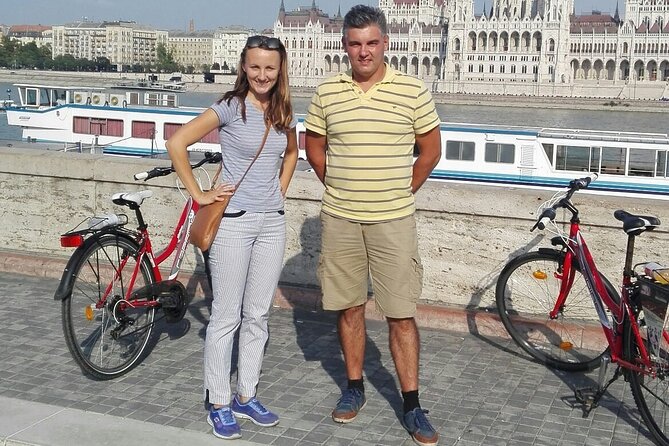
Then comes the main elevation moment: you cycle up to the Castle District. The good news is that this is the tour’s only hilly stretch, and it’s described as a brief climb. If you are using an e-bike, it tends to feel very manageable.
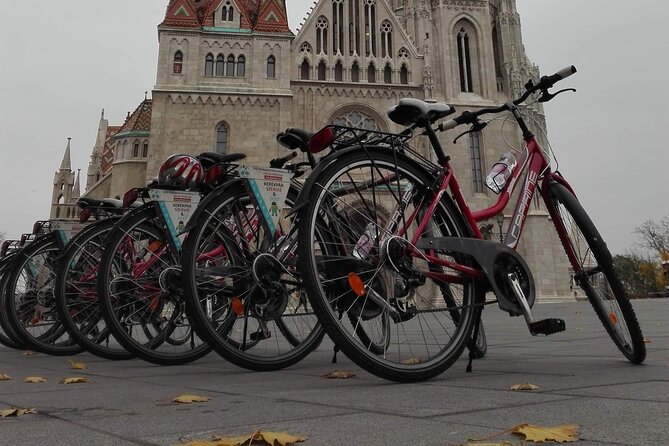
Once you reach the top, you get some of Budapest’s most classic sights. The district is home to Buda Castle (a UNESCO World Heritage Site) and Matthias Church, known for its striking Gothic architecture. You also pause long enough to breathe and regroup, which is important here because the viewpoint is the goal.
This is one of the best stops for photos looking back toward Pest, the Danube, and the Chain Bridge. The guide talks about medieval origins, royal residents, and why the area mattered strategically over time. Even if you are not a medieval-nerd, you’ll leave understanding why this part of town became the power center.
A practical consideration: if you have any back or knee issues, this is the segment to think about first. The tour itself notes it is not recommended for these problems unless you have an e-bike.
Margaret Island: the green lung reset in the middle of the ride
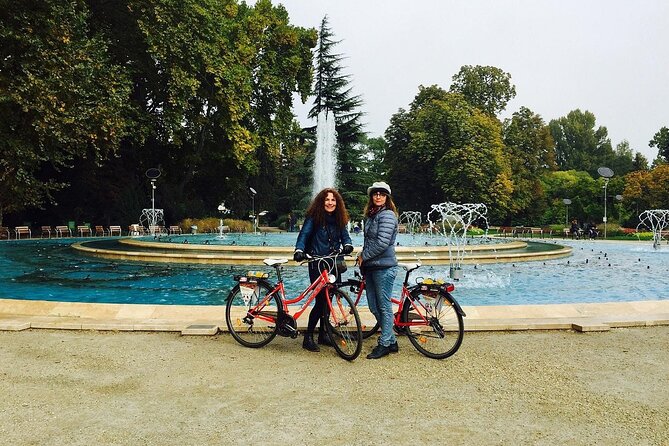
After the Castle District, you cycle down toward Margaret Island. This stop is a great counterbalance to the historic density above. The island is known as Budapest’s “green lung,” and it’s a place locals use to reset.
You’ll have time to enjoy gardens, greenery, and historic ruins. The guide also explains how the island’s role changed over centuries, including its time as a royal hunting reserve before becoming a public park. This stop is less about one specific building and more about atmosphere, space, and breathing room.
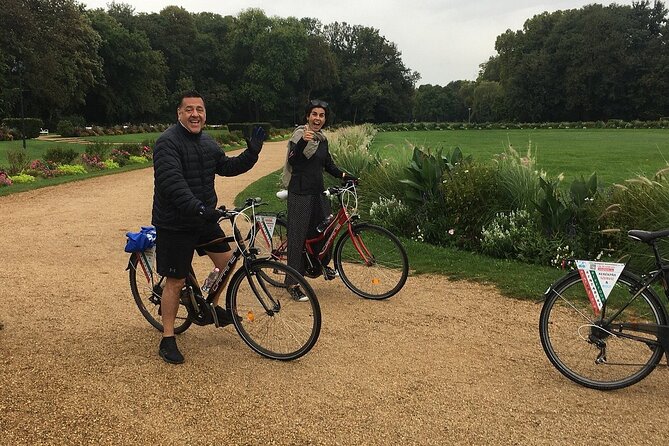
If you like to walk a little, this is your chance. You can stroll, relax, and photograph sights such as the Music Fountain and the medieval Dominican Convent ruins.
Hungarian Parliament Building: neo-Gothic, Danube reflections, and crown jewels
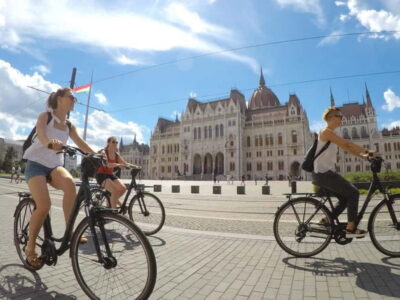
Next, you head to the Hungarian Parliament Building, one of the most dramatic skyline landmarks in the city. The building is neo-Gothic and also among the largest parliament buildings in the world, so you feel the scale right away.
The guide shares how it was constructed, how it fits into Hungary’s political life, and notable details like the crown jewels housed inside. Even if you do not go inside on this tour, you still get the context that makes it more than a photo stop.
The location is pure photography logic: you’re by the Danube, so the building’s reflection in the water becomes part of the picture. The short stop length still works because you’re aiming for angles more than long museum time.
One small timing tip: if you care about photos, position yourself early. You’ll get a moment, then the group moves on, so don’t wait until the crowd forms.
Liberty Square: twentieth-century Hungary, explained on the ground
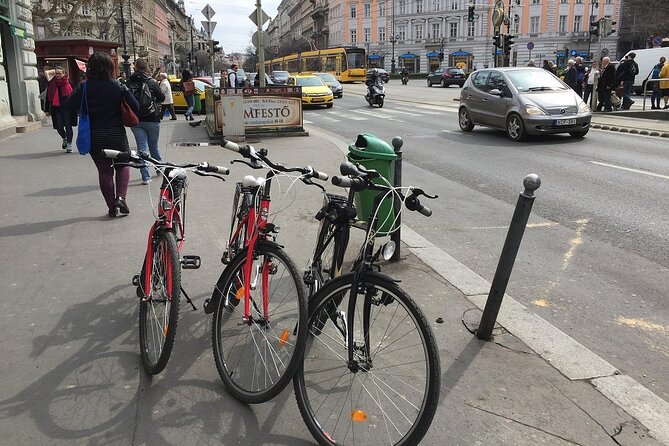
Then you ride to Liberty Square. This is where the tour shifts from grand architecture to modern political memory. The square includes monuments tied to Hungary’s complex twentieth-century experience under different occupations.
The guide narrates the stories behind monuments, including the Soviet War Memorial and the presence of the American Embassy. If you have ever felt that Budapest’s history can feel confusing, this stop helps you make sense of how public spaces preserve political narratives.
This is also a good stop for questions. If you want the guide’s take on what you are seeing elsewhere, this is a natural moment to ask. You’ll understand the “why” behind the stone.
St. Stephen’s Basilica (Szent István Bazilika): the mummified hand stop
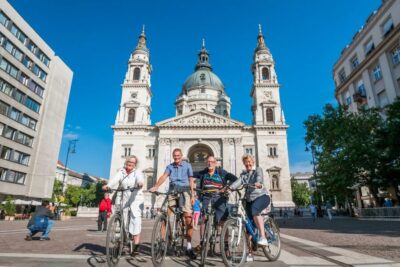
From there, you move toward St. Stephen’s Basilica, one of Budapest’s most important religious sites. The basilica is famous for its impressive dome and, more specifically, for a revered relic, the mummified hand of St. Stephen.
The guide also covers construction and how the basilica survived World War II, which is part of why the building feels so meaningful in the city’s memory. Even a brief stop gives you a chance to admire the façade details, and you may also be able to peek inside to see the interior.
Practical tip: if you are photographing the dome from outside, look for the cleanest line where the crowd is not blocking your frame. The stop is short, so aim for a simple shot that will actually come out.
Optional ride: Andrássy Avenue and the House of Terror
If you have time left, you may continue along Andrássy Avenue, a UNESCO-listed boulevard often compared to Budapest’s “Champs-Élysées.” As you bike down the avenue, the streetscape changes from river views to grand city architecture and cultural landmarks.
You’ll ride past highlights such as the Hungarian State Opera House and the House of Terror, a museum dedicated to the victims of fascism and communism. Whether you love museums or not, the point here is context. The guide ties these places to broader twentieth-century realities that you saw touched on earlier at Liberty Square.
This optional segment is also good for your “walk later” plans. Even if you do not stop inside the museum, seeing the building helps you decide whether you want to come back on a separate day.
Optional stop at Heroes’ Square, then a breather in City Park
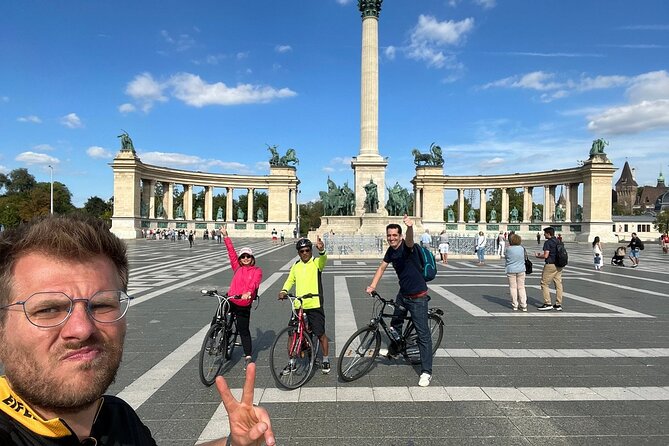
Another time-permitting add-on is Heroes’ Square, a monumental site tied to Hungary’s national leaders and its 1,000-year story. You’ll see the Millennium Monument at the center, and the guide explains the symbolism behind the statues.
Heroes’ Square sits beside the Museum of Fine Arts and the Palace of Art, so the architecture is part of the stage set. After that, City Park is nearby, giving you a calmer finish if you want one.
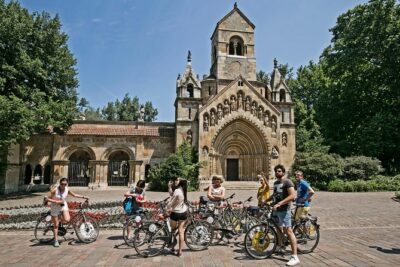
If the group energy is good, you can also look toward Vajdahunyad Castle and the boating lake area. Even without long wandering, this makes a satisfying end to a tour that started with hard city sights.
What to wear, bike choice, and comfort tips for the Castle climb
Budapest weather changes, and this tour runs in all conditions. Dress properly, especially for rain or cool wind along the river. Bring layers you can move in. A light rain jacket and long pants can save the day.
The ride is for most people, with an age limit of over 12. Your comfort depends mainly on the hill portion in the Castle District. The tour notes Castle District is the only hilly part and that it’s easier on e-bikes.
If you have back or knee problems, the tour is not recommended unless you use an e-bike. In other words, don’t tough it out with a standard bike if your body is likely to complain.
And yes, helmet and bottled water are included, so you can focus on riding instead of logistics.
If you are older or you want a smoother experience, ask about e-bikes when you book. One helpful theme from the tour team is that they try to make it comfortable for families too, so planning ahead pays off.
Getting the most out of a 3-hour loop on your first visit
I like this tour early in the trip. It gives you the city map in your head, not just in an app. After riding, you’ll know which viewpoints you want to repeat on foot.
Here’s how I’d pair it with your day:
- If you love churches and interiors, plan your longer indoor time after the bike tour, so the basilica and other stops make more sense.
- If you love architecture and museums, consider doing a museum follow-up day for places like the House of Terror.
- If you prefer slow travel, use the optional City Park area as your decompress moment, then take an easy walk afterward.
Also, because the tour is only about three hours, it is not ideal for travelers who want a long, deep museum day. It’s a “get oriented, see the anchors, learn the story” kind of half-day.
Who this tour suits best, and who might want a different plan
This is a great fit if you:
- Want major sights across Budapest without wasting time hopping between far apart locations
- Enjoy a guide who explains what you’re seeing in plain terms
- Like moving between photo spots instead of standing still
It is less ideal if you:
- Have back or knee problems and are not using an e-bike
- Need a very slow pace with lots of extended stops
- Have trouble riding for close to three hours total, even at a sightseeing tempo
If you are traveling with limited mobility, the e-bike suggestion is a key detail. If you are unsure, this is the segment to plan carefully around.
How the small group feel can change your experience
A maximum group size of 10 makes a real difference. You hear more, you can ask questions, and the guide can manage the ride better. With smaller groups, you often get more flexibility in how long you pause for photos.
One example that stuck with me conceptually: in a very small booking with guide Tomas, the experience became more like a true private guided loop, with extra attention to covering distance and keeping things comfortable. That’s not something to bank on, but it shows what the tour model is capable of.
Should you book this Budapest Grand Sightseeing Bike Tour?
Yes, if you want a smart first-pass through Budapest’s top viewpoints in about three hours, this is a strong option. You get included bike gear, a live English guide, and a route that links riverfront, bridges, Buda heights, major civic landmarks, and a calmer island break.
I would especially recommend it to first-timers who like photo stops with context and to anyone who appreciates a short, practical hill that you can manage with an e-bike. Skip it or switch to a more tailored option if your back or knees are likely to flare up on that Castle District climb.
If you’re on the fence, book it for a day you can dress for the weather, and treat it like your orientation tour. Then use the rest of your time in Budapest to slow down where you liked what you saw most.
FAQ
How long is the Budapes Grand Sightseeing Bike Tour?
It’s approximately 3 hours.
What does the tour cost?
The price is $45.66 per person.
Is the tour offered in English?
Yes, it is offered in English.
Where is the meeting point and where do you end?
You meet at Budapest, Semmelweis u. 14, 1052 Hungary, and the tour ends back at the same meeting point.
What’s included with the tour price?
The tour includes bicycle use, bottled water, a live guide, and a helmet.
How many people are in each group?
The tour has a maximum of 10 travelers.
Is there an age requirement?
Yes, participation is only allowed for travelers over age 12.
Is the tour suitable for people with back or knee problems?
It is not recommended for travelers with back or knee problems, except with an e-bike.
Does the tour run in bad weather?
Yes, the tour goes in all weather conditions, so you need to dress properly.
Newest from the Danube banks
- Gödöllö Royal Palace Privately with full board★ 5.0 · 1 review
- Private Budapest walking tour – 4 hours★ 5.0 · 1 review
- Private Budapest Tour with Thermal Bath or Market Visit★ 5.0 · 1 review
- Budapest Half Day Car Tour with Guide★ 5.0 · 1 review
- Budapest Private Transfer from Budapest city centre to Budapest Airport★ 3.0 · 1 review
- Magic Theme Team Adventure Game in the Streets of Budapest★ 5.0 · 1 review
- Budapest: Eat the Street, food tour with wine, 16+ tasting★ 5.0 · 1 review
- Private Transfer Budapest Airport BUD to Budapest by Car or Van★ 5.0 · 1 review
Cycling Tours, compared.

Budapest: Guided Bike & E-bike Tour with a Goulash
Read our review →Browse the lists this tour appears in