
Reviewed · BUDA CASTLE HILL TOURS
Buda Castle Tour: History and Architecture
Budapest history is best walked, not read. This 3.5-hour Buda Castle tour threads royal palace power, medieval neighborhoods, and 1686 siege memories into one easy route. You get an English-speaking, officially licensed guide plus a mobile ticket, and the small group stays to a maximum of 12.
I especially love how the tour explains the architecture as a timeline, not just as pretty stone. I also love the guide’s style, including the way Máté uses clear comparisons and even pulls up supporting visuals on an iPad when a detail needs context.
The main consideration is simple: it is a walking tour with uneven ground, and it is not suitable for limited mobility. Also, kids under 10 are not permitted, so plan for adult pace and some uphill Castle District steps.
In This Review
- Key things that make this tour work
- Royal Palace layers: from Sigismund’s era to the palace you see today
- Medieval commerce on Tárnok Street and noble entrances on Úri Street
- Mary Magdalene’s tower: a church site that survived demolition and war
- Italian Street, a Renaissance trace, and the finance building that rewrote the skyline
- Matthias Church area and Fortuna Street: the printing milestone on your walk
- From Becsi Kapu Square to the National Archives: markets and national memory
- Siege of Buda along the outer walls: where 1686 history becomes physical
- The Medieval Jewish quarter and the prayer house you can enter
- Reused walls and Dominican ruins under the Hilton: heritage versus progress
- Fisherman’s Bastion: the best views, with one terrace you will skip
- Price and value: how $43.25 makes sense here
- Getting the most from your 3.5 hours
- Who should book this Buda Castle architecture and history walk
- Should you book it? My practical call
- FAQ
- How long is the Buda Castle Tour?
- What does the tour cost?
- What is included in the tour price?
- What is not included?
- Is the Jewish praying house visit included, and when is it closed?
- Where does the tour start and end?
- Who can join, and is it okay for limited mobility?
Key things that make this tour work
- Royal Palace layers explained as real political change, from medieval stronghold to later styles
- Tárnok Street and Úri Street show everyday trade and noble life side by side
- You enter the Medieval Jewish prayer house, which is the tour’s only paid interior stop
- Siege of Buda points on the outer walls, so the history lands in the right place
- Small group size (max 12) keeps the pace human and the questions easy
Other ways up Castle Hill:
- Budapest: Buda Castle Cave Tour
★ 4.7 · 5,677 reviews - Budapest: Buda Castle District Vampires and Myths Night Tour
★ 4.6 · 3,830 reviews - Budapest: Buda Castle Walk with Saint Stephen’s Hall
★ 4.5 · 3,012 reviews
Royal Palace layers: from Sigismund’s era to the palace you see today
You start at the Statue of Prince Eugene of Savoy, right in the heart of Castle District energy, and then focus on the Royal Palace. This is one of those places where the building looks timeless, but the story never stops. Over the centuries, the palace was built, destroyed, and rebuilt, so you get architectural clues pointing to different eras and different power struggles.
The tour frames the Royal Palace as a physical record of turbulence. You hear how it began as a medieval stronghold and gradually transformed into a royal residence. Expect a look at the mix of stylistic elements, including Gothic, Baroque, and Neoclassical touches, and why that mix matters.
Right after, you briefly track the remains of the medieval Sigismund Church. Only a few minutes here, but it is a sharp moment: the Gothic-style royal chapel foundations are still visible in the courtyards below. It is the kind of stop that makes you look down and realize Buda Castle Hill has earlier monumental construction under your feet.
Medieval commerce on Tárnok Street and noble entrances on Úri Street
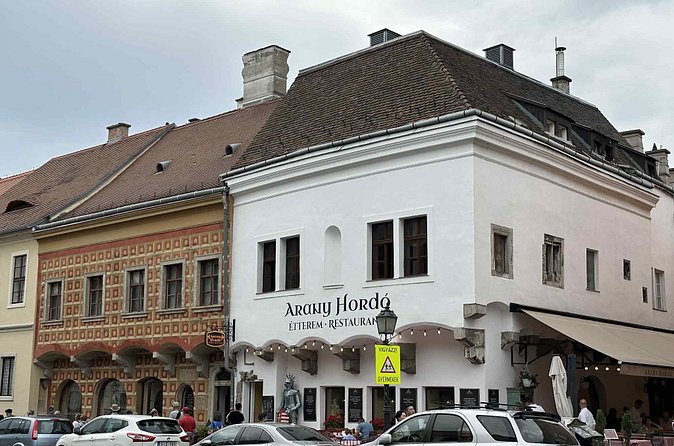
When the tour moves to Tárnok Street, you shift from royal scale to human scale. This cobbled lane was the main commercial street of the former burgher town under the court. The focus becomes practical: goods stored, traded, and displayed, with merchant houses that survived fire, siege, and urban change.
What I like about this part is that it explains how Buda worked on a daily basis, not just how rulers posed. You do not just walk past facades, you get the idea of what life looked like for shop owners and families running the Castle District from the ground level.
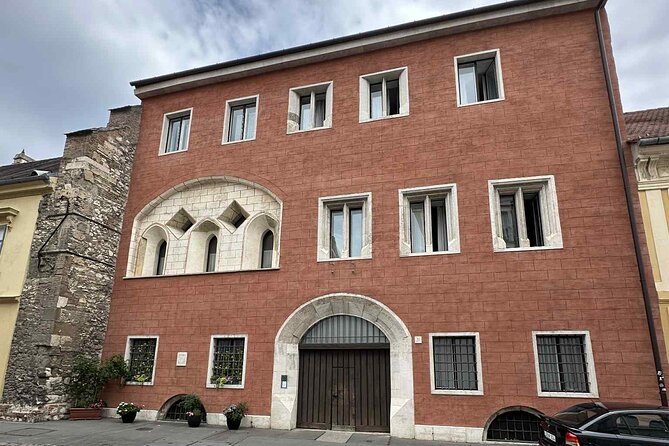
Then Úri Street brings you to the noble residential quarter. Here the tour highlights remnants of aristocratic palaces and residential houses, often on 14th to 15th century foundations. You also get the street’s standout feature, the ornate medieval gateways, where the arches and entrances hint at who was welcomed in and who came through as craftsmen and travelers.
If you like architecture, this is one of your best stretches for reading a street like a document. The tour makes the buildings feel like clues rather than background scenery.
Mary Magdalene’s tower: a church site that survived demolition and war
Next comes the Church of Saint Mary Magdalene site, and it has one of the most emotional arcs on the route. The church was built on the earliest church location on Castle Hill, with foundations dating back to the 13th century. It served the Hungarian-speaking parish of the area historically known as Szombathely.
You also learn about the siege of Buda in 1686, when the church was partially destroyed. Then the story takes a darker turn in the 1950s, when Hungary’s communist regime ordered demolition of the ruined structure. The key survival is the medieval tower, preserved through archaeologists and preservationists who fought to keep it.
This stop is short, but it changes how you view the hill. You stop thinking of the tower as an isolated landmark and start seeing it as persistence, even when the rest did not survive.
Italian Street, a Renaissance trace, and the finance building that rewrote the skyline
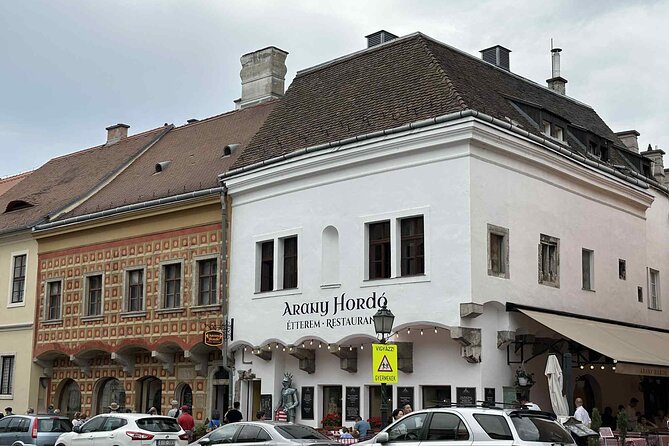
On Országház Street, the tour leans into the multicultural Buda angle. In medieval times this street was known as the Italian Street, home to Italian merchants who helped shape commercial and cultural life. You walk beneath grand medieval houses and noble residences and hear how 14th and 15th century prosperity affected the look of the neighborhood.
The standout detail here is the only surviving 16th-century sgraffito decoration in the entire Castle District. It is described as a delicate Renaissance trace against Gothic walls. Even if you do not know what sgraffito means, you will get the point quickly: you are seeing a rare surviving blend of styles that would have been easier to erase than preserve.
Then the tour passes the Neo-Gothic building now housing Hungary’s Ministry of Finance, originally built in the early 20th century. The catch is that the monumental design required demolishing several medieval structures. After World War II damage, the facade was stripped and simplified, and then in the last five years the original facade was reconstructed.
This part is useful because it complicates the usual “historic preservation is always good” story. The tour also mentions debate around the reconstruction process, including the fact that an original wing was demolished during the project. It makes you think about heritage as an ongoing decision, not just a fixed outcome.
Other centuries stacked along the Danube:



Matthias Church area and Fortuna Street: the printing milestone on your walk
The tour then heads to Matthias Church, officially named the Church of the Assumption of the Buda Castle. The guide notes a common mix-up: many people call it Matthias Church, but that is not its official name. It is a small but important correction because it shapes how you read signage and local references.
Next is Fortuna Street, where the mood changes from religious architecture to innovation and travel. Today it is known for restaurants, but in the Middle Ages it was home to aristocratic palaces and grand townhouses. The history highlight is the 1470s printing milestone, when Andreas Hess, a German-born printer, produced Hungary’s first printed book here, the Chronica Hungarorum.
Right nearby once stood the Red Hedgehog Inn (Vörös Sün), a legendary meeting point for travelers, merchants, and intellectuals. This is one of those moments where the tour helps you hear the past as a network, not a single event. You get a sense of ideas moving through Buda, because printers and inns were part of the same ecosystem.
From Becsi Kapu Square to the National Archives: markets and national memory
At Beci Kapu Square, the tour focuses on a former marketplace and a main entrance to medieval Buda. The story here is social and economic. In its heyday, the square was a meeting point where Hungarian townsfolk and the local Jewish community came together to trade, talk, and worship.
Even if you only spend around five minutes here, it is a good reset stop. The tour keeps returning to the idea that Buda Castle Hill was not only courts and churches. It was also commerce and community life.
Then you move to the National Archives of Hungary. This early 20th century building uses a Neo-Romanesque style to echo the medieval character of the Castle District. The arched windows and monumental stonework make it feel older than it is, but the point is deliberate blending into its surroundings.
More than an architectural choice, the tour explains it as national memory housed in real documents. Standing near it, you feel the theme of the tour: layers. The city keeps rewriting itself while trying to hold onto what mattered.
Siege of Buda along the outer walls: where 1686 history becomes physical
Next you reach Arnavut Abdurrahman Abdi Paşa Emlékműve, along the outer castle walls. This is where the 1686 Siege of Buda gets anchored to location. You learn where the walls were first breached by Christian allied forces, and you also hear about where the Ottoman Pasha of Buda fell in battle.
A memorial like this is not for drama. It is a reminder that the architecture you are walking past was tested under pressure, including fire and siege. The multinational aspect of the memorial for Christian soldiers is part of the tour’s message that the “battle history” has multiple identities, not one neat label.
If you like WWII history, this might be your most direct contrast stop, since you are looking at multiple layers of conflict across centuries.
The Medieval Jewish quarter and the prayer house you can enter
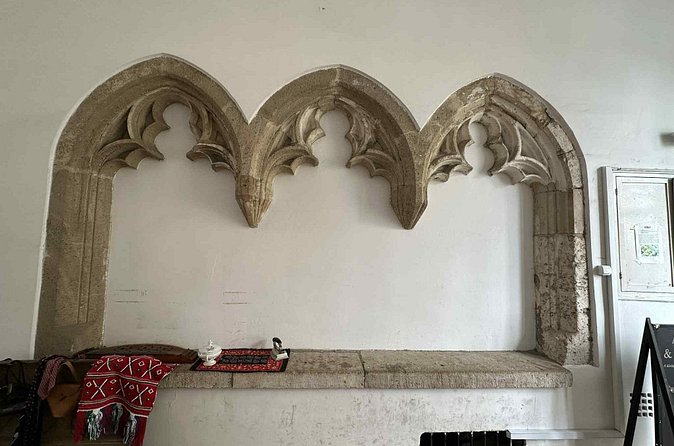
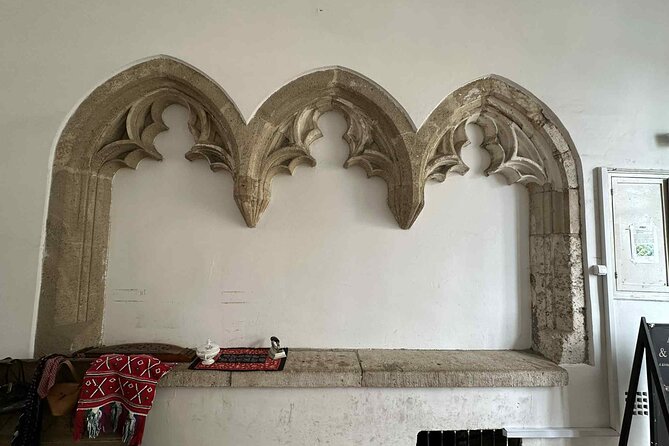
This is one of the tour’s best practical wins: the Mediaeval Jewish Chapel, including a visit to the excavated medieval Jewish prayer house. You enter a space described as one of the rare surviving examples of Jewish religious architecture from the Middle Ages in Hungary.
The tour notes it is modest in size, but packed with meaning. You pause at the site of a former Gothic synagogue and then step into the prayer house where you can connect daily life and resilience to physical remains. The theme here is quiet, not loud. It makes the whole walk feel more human.
Important timing note: the included entrance is closed on Saturday and Monday. If your dates fall on either day, you will want to plan for that ahead of time so you are not disappointed.
Reused walls and Dominican ruins under the Hilton: heritage versus progress
On Táncsics Mihály utca, you see how Buda rebuilt itself rather than wiping the slate clean. The tour explains how medieval ruins were reused during the 17th and 18th centuries. Old Gothic walls and cellars were incorporated into later Baroque and residential buildings, meaning you can still spot earlier layers folded into newer life.
Then you reach Dominikánus Udvar, where the remains of the Dominican monastery of Saint Nicholas sit in a very 20th century context. The tour includes a story linked to this Dominican order, Friar Julianus and his journey in the 13th century.
The ruins endured fire, siege, and neglect, then were reinterpreted during Hilton construction in the 20th century. The result is described as a controversial blend of medieval stonework and modern architecture. That controversy matters because it adds honesty to the preservation conversation: sometimes protecting the past comes with tradeoffs.
Fisherman’s Bastion: the best views, with one terrace you will skip
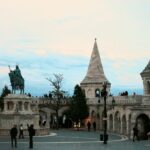
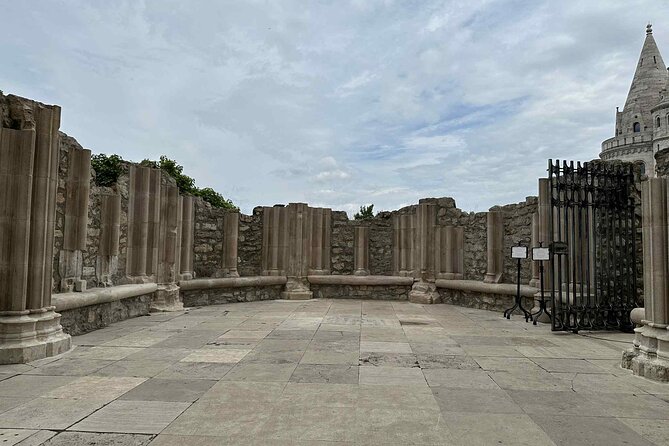
The final stop is Fisherman’s Bastion, one of Budapest’s most iconic sights. At its center is the equestrian statue of King Saint Stephen, Hungary’s first Christian king, presented as symbol of the birth of the Hungarian state.
You will admire the monument and the structure from the main level. The tour explicitly does not include entry to the upper panoramic terrace, because access requires a ticket on-site. That is a good heads-up for planning your time. If you care about the highest viewpoints, you can add it after the tour, but you should budget for extra ticket time.
This is a satisfying wrap because you end with a place that is both landmark and viewpoint. After hours of stone layers, it feels great to stand back and see the whole city.
Price and value: how $43.25 makes sense here
The tour is listed at $43.25 per person, and the value depends on what you care about most: guided interpretation plus one included interior.
On the plus side, the price covers an officially licensed English-speaking guide and the included entrance fee to the Jewish prayer house. Most other stops are described as free admission, which means you are paying mainly for the thinking and the route, not a long chain of paid attractions.
On the downside, you do not get interior access to every major name on the map. The Royal Palace interior is not included, and the Matthias Church interior is not included either. Upper terrace access at Fisherman’s Bastion also costs extra.
For me, this makes the tour best for travelers who want structure and clarity more than they want a checklist of museum rooms. If you plan to visit the Royal Palace and church interiors separately, the tour becomes a strong foundation.
Getting the most from your 3.5 hours
This is about 3 hours 30 minutes of walking, with a schedule made of quick, focused stops. The group stays small, up to 12 people, which helps when you have questions about why one facade changed or what a site used to be.
You should have moderate physical fitness, and you should expect uneven surfaces. Castle District streets can be steep and slippery when the weather turns, so good shoes matter more than you think.
The tour mentions it requires good weather. If the forecast looks rough, you may need to be flexible with dates, because the experience is built around walking between sites.
Also, the itinerary includes some shorter time windows, like three to five minutes at certain points. If you want photos, plan for quick stops rather than long lingering at every corner.
Who should book this Buda Castle architecture and history walk
Book it if you want a guided route that explains how Buda’s buildings reflect politics, war, and daily life. It also fits well if you like architectural details, street-level history, and religious sites beyond the postcard versions.
I would especially recommend it for:
- First-time visitors who want orientation fast
- Travelers who care about the medieval layers under the palace view
- People who like heritage discussions that include preservation tradeoffs
I would skip it if:
- You have limited mobility and cannot handle a walking route on uneven ground
- You are traveling with kids under 10
- You only want indoor museum time, since several major interiors are not included
Should you book it? My practical call
Yes, if you want your Buda Castle visit to make sense. The best part is the combination of architecture-as-timeline plus a guided walk through medieval commerce, siege memory, and the included Jewish prayer house.
If you already plan to spend extra time inside the Royal Palace and Matthias Church, this tour sets you up beautifully. And if you are picky about view tickets, remember the Fisherman’s Bastion upper terrace is not included, so decide upfront if you want that extra stop after.
FAQ
How long is the Buda Castle Tour?
The tour lasts about 3 hours 30 minutes.
What does the tour cost?
The price is $43.25 per person.
What is included in the tour price?
It includes an officially licensed English-speaking tour guide, a guest pass with lanyard, and entrance to the Jewish praying house.
What is not included?
Entrance to the interior of Matthias Church is not included. Admission to the Royal Palace interior is not included. Access to the upper panoramic terrace at Fisherman’s Bastion is also not included.
Is the Jewish praying house visit included, and when is it closed?
Yes, entrance to the Jewish praying house is included, but it is closed on Saturday and Monday.
Where does the tour start and end?
It starts at the Statue of Prince Eugene of Savoy, Budapest, and ends at Matthias Church, right by Szentháromság Square.
Who can join, and is it okay for limited mobility?
Children under 10 are not permitted. It is not suitable for guests with limited mobility, and travelers should have a moderate physical fitness level.
Newest from the Danube banks
- Pub Crawl Through The Ruin Bars in Budapest with T-shirt Included★ 4.5 · 14 reviews
- Rudas Bistro Premium Brunch★ 3.5 · 14 reviews
- Wine Tasting in the Countryside from Budapest★ 5.0 · 14 reviews
- Buda Castle District and Matthias Church Private Tour★ 5.0 · 14 reviews
- Pest side stories with a Historian★ 5.0 · 14 reviews
- Recirquel Company: Walk My World Immersive Show Entry Ticket★ 4.6 · 14 reviews
- Ram Gorge Hiking Adventure★ 5.0 · 14 reviews
- Budapest Rafting – Sunset Cruise★ 5.0 · 14 reviews
Buda Castle Hill Tours, compared.
Budapest: Buda Castle District Vampires and Myths Night Tour
Read our review →
Budapest: Buda Castle Walk with Saint Stephen’s Hall
Read our review →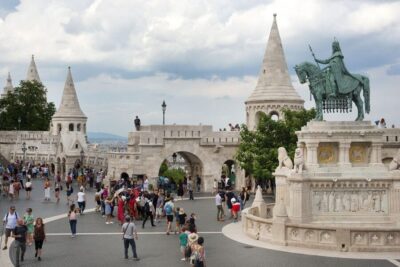

Budapest: 3-Hour Grand City Tour and Castle Walk
Read our review →
Buda Castle District Dark History, Legends and Vampire Night Tour
Read our review →
Budapest: Buda Castle District Walking Tour with a Historian
Read our review →
Browse the lists this tour appears in