
Reviewed · WALKING TOURS
Budapest Art Nouveau Walking Tour
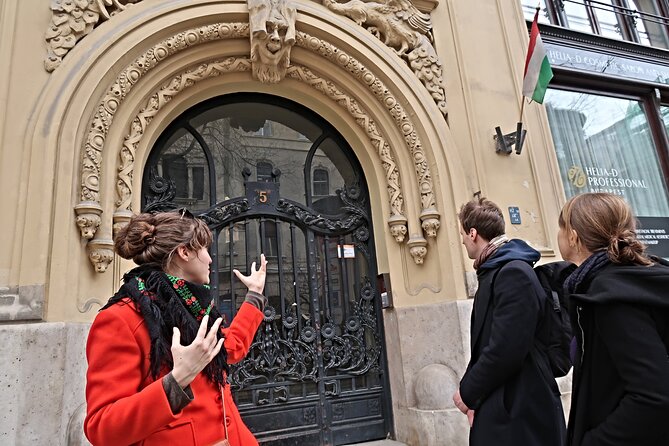
Budapest wears flowers in stone. I love the stop-by-stop focus on Art Nouveau details, and I love walking with an historian guide who connects each facade to Budapest’s bigger story. The only catch is the start area can feel crowded, so give yourself a few extra minutes to find the group.
This tour is built around one style and one set of ideas, so you start noticing patterns fast. You’ll hear how Hungary’s best-known Art Nouveau architect, Ödön Lechner, earned a nickname as the Gaudí of Hungary, and you’ll spot his design fingerprints in places like the Royal Postal Savings Bank.
Plan for a relaxed but active half day. You’ll cover a few highlights on foot and use some public transport, and while the first three stops are free to enter, the Kazinczy Street Synagogue visit depends on the day and costs extra if entry is available.
In This Review
- Key Points at a Glance
- Budapest Art Nouveau: Why This Style Makes Sense Here
- Price and Time: Is $126.16 Worth It for Three Hours?
- Starting at Madal Cafe: A Simple Tip for Not Losing Your Group
- Stop 1, Gresham Palace: From Luxury Hotel to Art Nouveau-Adjacent Grandeur
- Stop 2, Postatakarek Bank: The Royal Postal Savings Bank and Lechner’s Signature Style
- Stop 3, Thonet House: Tiles, Zsolnay Ceramics, and Why Pécs Matters
- Stop 4, Kazinczy Street Synagogue: Art Nouveau Decoration in an Active Community Site
- The Walking Pace and the Public Transport Twist
- Who This Tour Best Suits (and Who Might Want Something Else)
- Should You Book the Budapest Art Nouveau Walking Tour?
- FAQ
- How long is the Budapest Art Nouveau Walking Tour?
- Where does the tour start and end?
- What language is the tour in?
- Is this a small-group tour?
- What is included in the tour price?
- Are entrance tickets included?
- Is visiting the synagogue interior always included?
- Does the tour include public transportation?
- How much walking should I expect?
- What is the cancellation policy?
Key Points at a Glance
- Small-group feel: Limited to a group size of up to six, with an overall maximum of eight travelers.
- Historian guide focus: You get design and history explained in a clear, walk-and-look way.
- Lechner spotlight: You’ll connect multiple buildings to the same Art Nouveau language.
- Tile and ceramic clues: You learn why Hungarian Art Nouveau became famous for tiled facades and decorative ceramic work.
- Royal Postal Savings Bank interior: The entrance hall design is part of the story, not just the exterior.
- Optional synagogue interior: Except on Saturdays, you can go inside Kazinczy Street Synagogue.
More of Pest crossed at walking pace:
- Budapest: Buda Castle Walk with Saint Stephen’s Hall
★ 4.5 · 3,012 reviews - Big Bus Budapest Hop-On Hop-Off Bus and Walking Tour
★ 3.5 · 2,206 reviews - Budapest: Buda Castle District Walking Tour
★ 4.6 · 2,108 reviews
Budapest Art Nouveau: Why This Style Makes Sense Here
Budapest is one of those cities where architecture isn’t background noise. Art Nouveau shows up like a visual accent, then keeps showing up until you realize it is a real idea shaping whole streets.
On this walking tour, you learn how the movement took hold and why it mattered. You’ll talk about the style’s history, and then you’ll connect those ideas to specific design choices you can see with your own eyes. That’s the value: not just naming buildings, but understanding why they look the way they do.
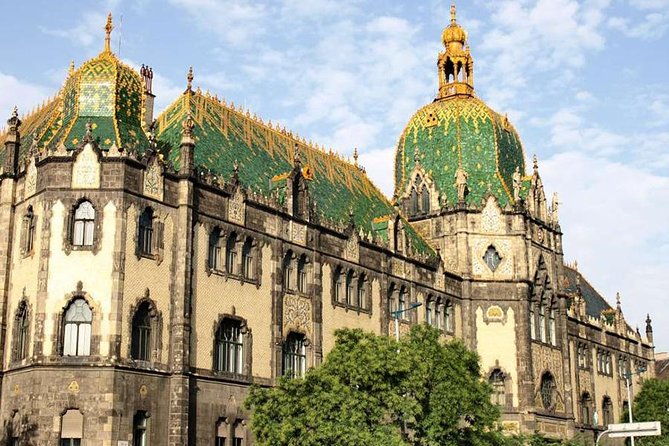
A big theme is how Hungarian Art Nouveau became known for ornamental tiles and decorative surfaces. Once you understand that, you start seeing the difference between Art Nouveau that looks pretty and Art Nouveau that’s doing something cultural and architectural at the same time.
And because the guide is an historian, the conversation stays grounded. You’ll hear about Ödön Lechner not as a trivia name, but as the architect who helped define the look of a modernizing Budapest.
Price and Time: Is $126.16 Worth It for Three Hours?
At $126.16 per person for about 3 hours, this isn’t the cheapest way to see a few buildings. What makes it feel fair is the mix of guided interpretation plus entry access at stops that are free.
You’re paying for:
- A historian guide who explains architecture as you walk.
- A route that concentrates on major Art Nouveau examples instead of a scattershot sightseeing loop.
- Multiple interior moments, including the entrance hall focus at the Royal Postal Savings Bank.
Also, the tour is small-group. That matters because you can actually ask questions, and you’re not shouting over a crowd.
One thing to budget for: public transport passes are at your own expense, and the Kazinczy Street Synagogue entry is not included. If you’re the type who hates extra charges, this tour still works, but you should plan for that last stop.
Starting at Madal Cafe: A Simple Tip for Not Losing Your Group
The tour meets at Madal Cafe, Alkotmány u. 4 (1054). It’s a workable spot because it is near public transportation, but it can also be busy.
My practical advice is boring, but it works: arrive a few minutes early, and check that you’re standing where the group actually forms. If you think you’ll be fine because you have the address, don’t. The start is in a lively area, and it is easy to miss each other.
Wear comfortable shoes. This is a walking tour with a moderate amount of walking, plus some public transport along the route.
Stop 1, Gresham Palace: From Luxury Hotel to Art Nouveau-Adjacent Grandeur
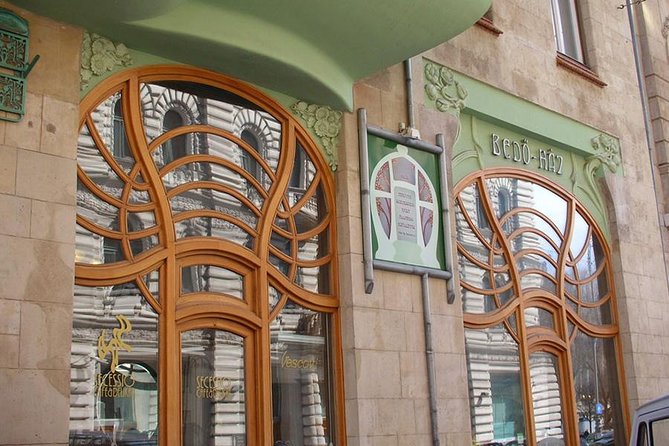
You start with Gresham Palace, a standout facade that also has an impressive interior. Today it’s Budapest’s most luxurious hotel, but the building also has history as office space and a series of luxury apartments.
Why this stop works on an Art Nouveau tour is that it sets the tone. You get to see how Budapest’s late-era architecture used bold styling and strong visual design to signal status and modern city life. The exterior is the first clue, and the interior details help you read the building like a text.
You’ll spend about 20 minutes here, and admission is free for this stop.
A quick consideration: since it is a hotel today, you might want to slow down and look at details without rushing. The guide’s job is to steer your eyes, but your job is to stay curious for a few extra seconds at each facade element.
Other ways an evening in Budapest can go:





Stop 2, Postatakarek Bank: The Royal Postal Savings Bank and Lechner’s Signature Style
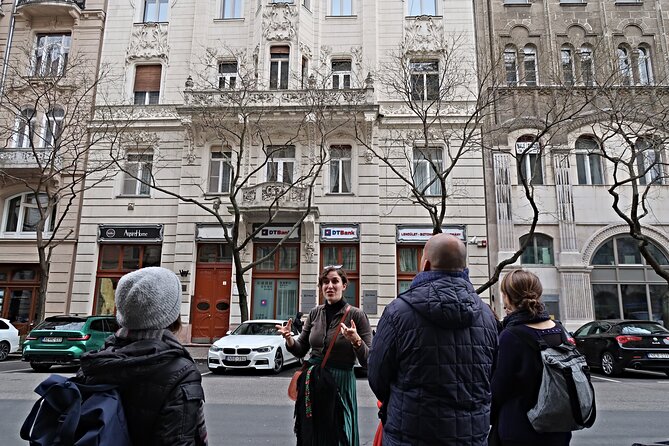
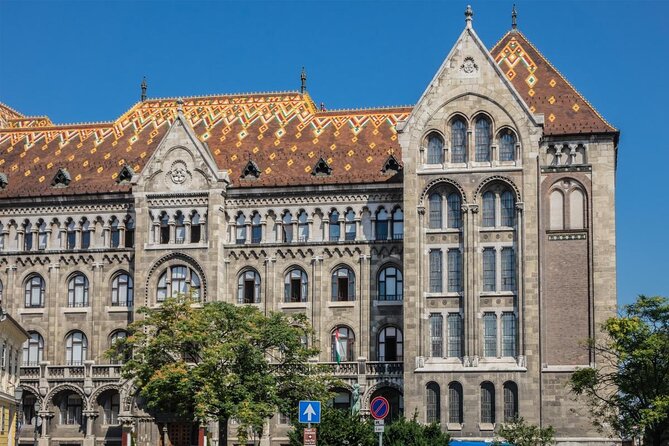
Then you head to Postatakarek Bank, officially known as the Royal Postal Savings Bank. This one is designed by Ödön Lechner, the architect often compared to Gaudí for his imaginative approach.
This stop is the heart of the Lechner story because it combines flamboyant exterior energy with design thinking you can study up close. You’ll discuss interior design elements of the entrance hall, which is exactly the kind of detail that most quick photo stops miss.
Expect about 20 minutes. Admission is listed as free for this stop, so it’s a nice payoff without extra costs.
What I like about this part of the tour is that the guide makes style practical. You learn what to look for when you’re standing in front of an Art Nouveau entrance: the way decoration guides your eye, how the space feels composed, and how the building’s identity comes through in the details.
If you love architecture, this is the moment that makes the rest of the tour click.
Stop 3, Thonet House: Tiles, Zsolnay Ceramics, and Why Pécs Matters
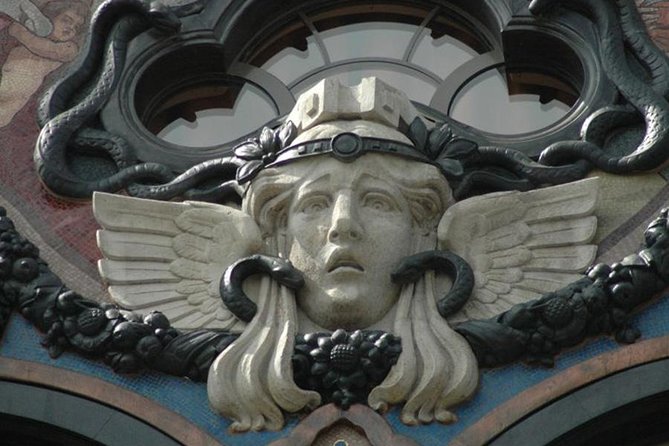
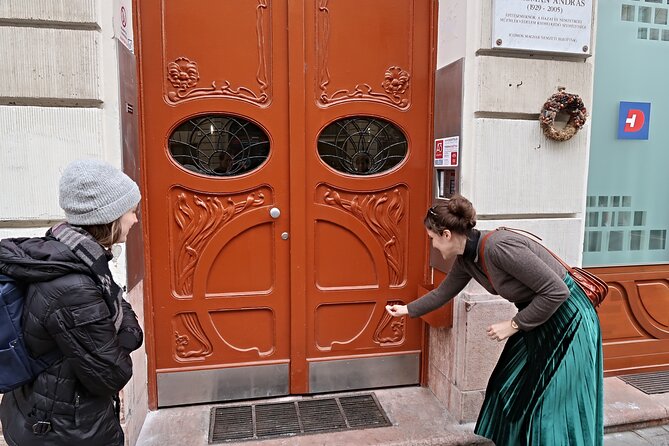
Next up is Thonet House, where the focus shifts toward materials. The big lesson here is how Hungarian Art Nouveau became famous for tiled facades, and how specific ceramic innovation made that look possible.
You’ll pause at Thonet House and learn about Zsolnay porcelain and ceramics from Pécs, in southern Hungary. That might sound like a geography detour, but it isn’t. It helps explain why Budapest’s Art Nouveau decoration looks the way it does, instead of feeling random or purely decorative.
You’ll spend about 20 minutes, and admission is listed as free.
This is one of those stops where you benefit from taking a few steps back and then moving closer again. The details can look busy if you only view them up close. If you view the facade as a whole first, then zoom in mentally, the design choices start making sense.
If you’re the kind of traveler who likes understanding how art and industry meet, this stop delivers.
Stop 4, Kazinczy Street Synagogue: Art Nouveau Decoration in an Active Community Site
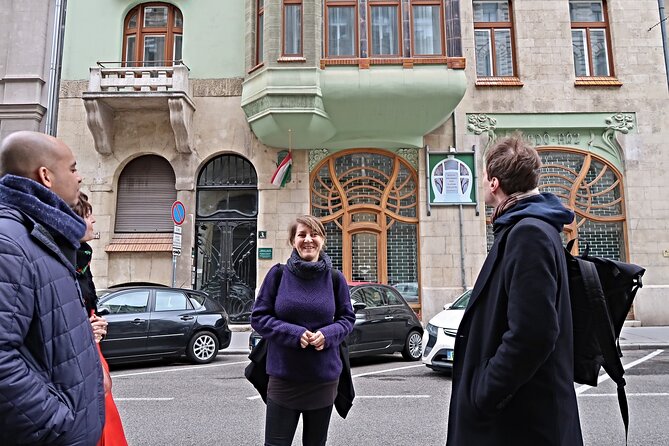
The tour concludes at Kazinczy Street Synagogue, described as an Orthodox synagogue decorated in Art Nouveau style. You’ll spend about 25 minutes here.
Important practical point: except on Saturdays, you enjoy a visit to the synagogue interior. On Saturdays, the interior visit is not part of the plan, so your experience will be more exterior-focused.
Admission for this stop is not included. There could be an additional cost if the Orthodox Synagogue on Kazinczy Street is open on the day of your tour.
This is also where you should manage expectations. Religious sites require a bit of respect and patience, and you may need to follow local rules on timing and access. Even with a guided stop, it’s still a living place for a community.
Why it belongs on an Art Nouveau tour: it shows you that the style is not locked in one type of building. It can show up in a synagogue, a bank, a palace, and a shopfront context, reflecting the broader artistic ambitions of the city.
The Walking Pace and the Public Transport Twist
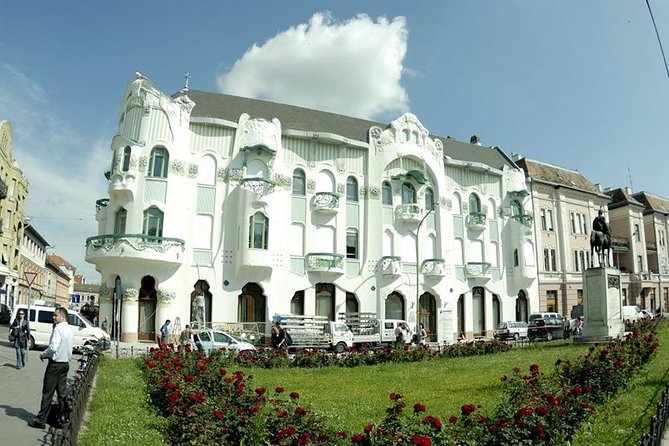
This tour includes a moderate amount of walking, with some use of public transport. You’ll have public transport passes available in the sense that you might use them, but the passes are at your own expense, since they are not included.
So think of it like this: you’re not trudging across town, but you also aren’t doing a stop-and-scoot photo route. The pacing is meant to keep you comfortable while giving the guide time to explain design choices at each building.
What to bring is simple: comfortable shoes, and be ready for a bit of city walking. If you’re sensitive to crowds, note that the meeting area can be busy, so plan for that on arrival.
Who This Tour Best Suits (and Who Might Want Something Else)
This tour is a great fit if you:
- Like architecture and want to understand what you’re looking at, not just take photos.
- Want a focused route centered on one style, Art Nouveau, with recognizable examples.
- Appreciate a guide who can connect buildings to named designers like Ödön Lechner.
You might choose another kind of tour instead if:
- You want only exterior views and hate any extra costs for entry.
- You dislike walking or prefer very long, unhurried stops.
- You want a bigger emphasis on broader Hungarian history beyond architecture, since this route keeps its scope on design and style.
Should You Book the Budapest Art Nouveau Walking Tour?
If you want a guided Art Nouveau education that stays grounded and practical, I’d book it. The biggest reason is the way the tour is built: a historian guide, a tight route, and multiple chances to see decoration up close without a junky itinerary filled with filler.
This is especially compelling if you care about details like tiles, ceramics, and interior entrance hall design. Those elements are the difference between thinking Art Nouveau is just pretty and actually understanding why Budapest looks the way it does.
One more confidence boost: the tour scores extremely well overall, with a strong recommendation rate and consistent praise for the guide’s ability to tell the story clearly. That matches the style of experience you’ll get here: you walk, you look, and you learn what to see next.
My final tie-breaker advice is about the synagogue day. If your schedule lands you on a Saturday, plan for an exterior-focused ending, since the interior visit is excepted on Saturdays.
FAQ
How long is the Budapest Art Nouveau Walking Tour?
It lasts about 3 hours.
Where does the tour start and end?
It starts at Madal Cafe, Alkotmány u. 4, 1054 Hungary. It ends at Budapest Orthodox Synagogue, Kazinczy u. 29-31, 1075 Hungary.
What language is the tour in?
The tour is offered in English.
Is this a small-group tour?
Yes. It is a small-group tour limited to a maximum of six, with an overall maximum of eight travelers.
What is included in the tour price?
The tour includes a historian guide.
Are entrance tickets included?
Admission is free for the first three stops. Admission for Kazinczy Street Synagogue is not included.
Is visiting the synagogue interior always included?
Except on Saturdays, you enjoy a visit to the synagogue’s interior. On Saturdays, interior access is not included as part of the plan.
Does the tour include public transportation?
There is some use of public transport, but public transportation passes are at your own expense.
How much walking should I expect?
Expect a moderate amount of walking. Comfortable shoes are recommended.
What is the cancellation policy?
You can cancel for a full refund up to 24 hours in advance of the experience start time.
Newest from the Danube banks
- Pub Crawl Through The Ruin Bars in Budapest with T-shirt Included★ 4.5 · 14 reviews
- Rudas Bistro Premium Brunch★ 3.5 · 14 reviews
- Wine Tasting in the Countryside from Budapest★ 5.0 · 14 reviews
- Buda Castle District and Matthias Church Private Tour★ 5.0 · 14 reviews
- Pest side stories with a Historian★ 5.0 · 14 reviews
- Recirquel Company: Walk My World Immersive Show Entry Ticket★ 4.6 · 14 reviews
- Ram Gorge Hiking Adventure★ 5.0 · 14 reviews
- Budapest Rafting – Sunset Cruise★ 5.0 · 14 reviews
Walking Tours, compared.

Budapest: Buda Castle Walk with Saint Stephen’s Hall
Read our review →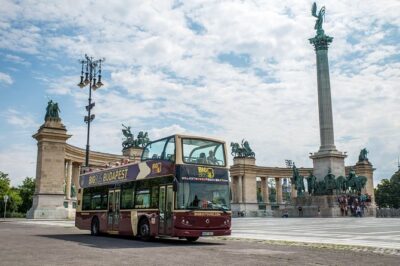
Big Bus Budapest Hop-On Hop-Off Bus and Walking Tour
Read our review →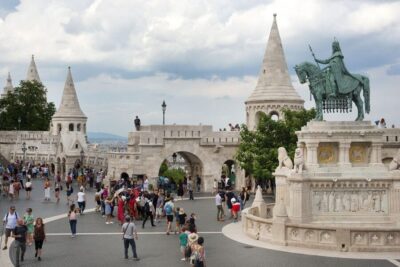
Budapest City Landmarks Walking Tour in 2 Hours
Read our review →
3-Hour Orientation Walking Tour of Buda and Pest
Read our review →
Budapest: 3-Hour Grand City Tour and Castle Walk
Read our review →
Budapest Historical Sightseeing – Free Walking Tour
Read our review →
Budapest All in One Small Group Walking Tour with Strudel Stop
Read our review →Browse the lists this tour appears in