

Reviewed · JEWISH DISTRICT TOURS
PRIVATE GUIDED Budapest Jewish Heritage walking Tour
Some places teach you with silence.
This private Jewish Heritage walking tour connects Budapest’s Holocaust-era story with living Jewish culture, using synagogues and memorials along one tight route. I like that it mixes big, unforgettable outdoor stops with inside looks at Orthodox and Neolog synagogue architecture. One thing to consider: it’s a walking tour with good-weather requirements, so plan comfy shoes and a flexible attitude if conditions change.
What makes it especially interesting is how the stops layer together. You start at the ghetto’s physical remains, then move to major synagogues still serving communities, then land on two Holocaust memorials that hit hard and linger. Your guide explains what you’re seeing, and the pacing works well for a short, focused visit without turning into a lecture marathon.
Price-wise, at $60.49 per person for a private tour, it’s not a bargain-bucket deal, but it can feel like strong value when you want context you can ask questions about. If you prefer to wander on your own with no set route, you may feel guided time is more than you need.
In This Review
- Key highlights you will actually notice
- A 2-hour private Jewish Heritage walk through Budapest’s key sites
- Meeting at Starbucks FashionBudapest and how the walk is paced
- Stop 1: The Ghetto Memorial Wall and how the wall tells you the story
- Stop 2: Kazinczy Street Synagogue, Art Nouveau style with Orthodox roots
- Stop 3: Rumbach Street Synagogue and Moorish Revival with Neolog traditions
- Stop 4: The Carl Lutz Memorial, the person who turned documents into protection
- Stop 5: Dohány Street Synagogue, the Great Synagogue of Budapest
- Stop 6: Shoes on the Danube Bank, why this memorial hits so hard
- The real value of a guide here, not just a checklist of stops
- Price and practical value at $60.49 per person
- Timing, weather, and what to wear for a comfortable Jewish Quarter walk
- Should you book this Budapest Jewish Heritage walking tour?
- FAQ
- How long is the Budapest Jewish Heritage walking tour?
- What is the tour price per person?
- Where does the tour start and end?
- Is the tour private?
- What language is the tour offered in?
- Is a tour guide included?
- Do the stops require paid admission tickets?
- What if the weather is bad?
- FAQ
- What is the cancellation policy?
Key highlights you will actually notice
- A tight 2-hour route that hits six major sites without wasting time cutting across town
- Three major synagogues with different styles and community histories (Orthodox, Neolog, and the Great Synagogue)
- Specific Holocaust references tied to named dates, places, and people, not vague generalities
- Carl Lutz Memorial with a dramatic bronze sculpture and a clear explanation of how he saved lives
- Shoes on the Danube Bank as a powerful, hands-on-feeling memorial you cannot unsee
- English-speaking private guide plus free admission at the listed stops
Other walks through the old Jewish quarter:
- Budapest Jewish Heritage Memorial Walking Tour & Synagogue Entry
★ 5.0 · 568 reviews - Budapest: Jewish Heritage Guided Tour with Synagogue Ticket
★ 4.8 · 533 reviews - German tour in the Budapest city centre & the Jewish quarter
★ 5.0 · 359 reviews
A 2-hour private Jewish Heritage walk through Budapest’s key sites
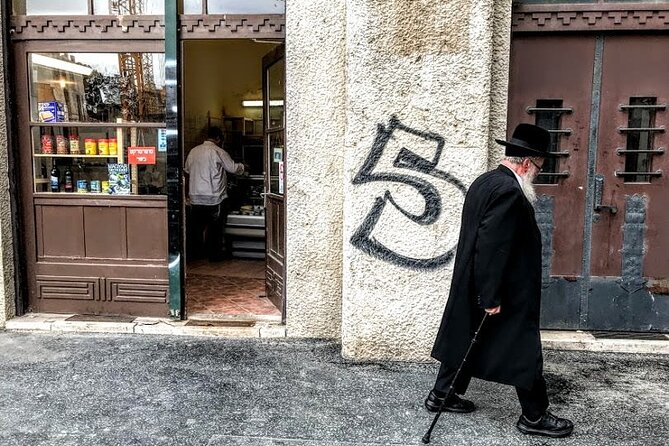
Budapest can feel like two cities stacked together: grand views one minute, painful history the next. This tour helps you hold both ideas at once, which is exactly what you want from a Jewish heritage walk in a city where Jewish life, persecution, and survival all left visible marks.
It’s private, so it’s only your group, and the guide can shape the pace to what you care about. The tour is offered in English and runs about 2 hours. You get a mobile ticket, and the route starts and ends at the same place, which keeps logistics simple.
For value, the price is $60.49 per person and includes the tour guide. The stops are listed with free admission tickets, so you are mostly paying for guided context and time, not museum fees. In my view, that’s the real bargain here. You are paying to understand the why, not just to look at the what.
Meeting at Starbucks FashionBudapest and how the walk is paced
You meet at Starbucks FashionBudapest, Deák Ferenc u. 23, 1052 Hungary. It’s in a central spot near public transportation, which matters in Budapest because street navigation can be fast and slightly confusing, even when you know the main roads.
The tour ends back at the meeting point, so you do not have to solve a second “how do I get home” problem. With about six stops and an overall time of roughly 2 hours, expect short transitions. Each stop is timed generously enough to look up, read what’s there, and listen without the guide rushing you through like you’re late for a train.
The one practical catch: the experience requires good weather. These are outdoor segments, especially the ghetto memorial and the Danube riverside stop. If rain or cold hits, you’ll need to trust the operator to offer a different date or a full refund.
Stop 1: The Ghetto Memorial Wall and how the wall tells you the story

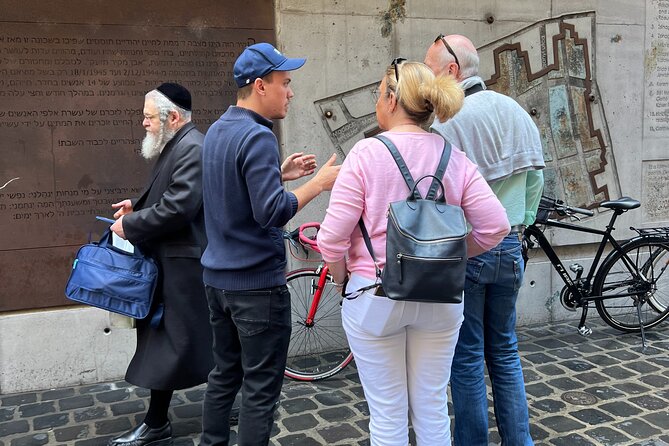
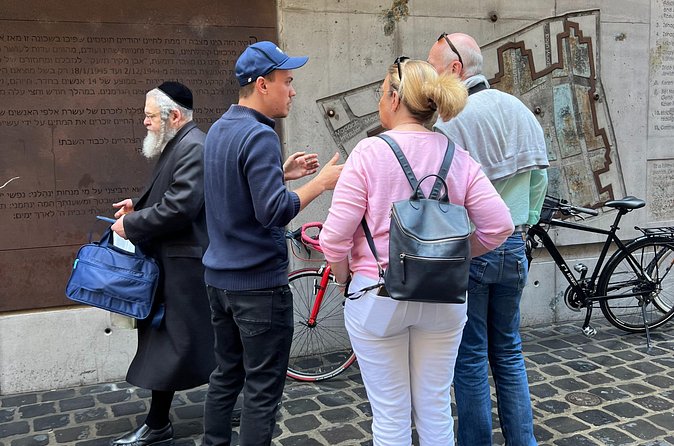
The first stop is the Ghetto Memorial Wall. The key visual detail is right in front of you: holes in the wall that offer a glimpse into Jewish life in Budapest, both past and present. It’s the kind of design choice that forces you to lean in, literally and mentally, instead of just reading a plaque from a distance.
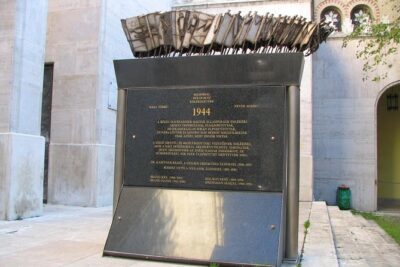
Then your guide connects the wall to a specific turning point. On 29 November 1944, Gábor Vajna, Minister of Internal Affairs of the Arrow Cross organization of Hungary, released the Decree on the Establishment of the Budapest Ghetto. That decree led to a forced relocation.
You’ll get the geography in plain terms: the Budapest Jews were pushed to an area in the 7th district enclosed by the streets around the Dohany, Kertesz, Kiraly, Csanyi, Rumbach, Imre Madach, and the Karoly ring road. On 10 December, the area was locked down, and at the entry the sign appeared: christians forbidden entry.
The details can feel almost too sharp. By the next January, almost 70,000 people were crowded into apartments in the enclosed zone, and many were stuck outside on the streets. It’s a crushing reminder that persecution wasn’t only violence. It was also forced confinement, surveillance, and deprivation.
A useful added note: 2014 marked the 70th commemoration of the formation of the Budapest ghetto. It’s worth letting that sink in because these memorials are not just history objects. They are places locals keep revisiting.
Stop 2: Kazinczy Street Synagogue, Art Nouveau style with Orthodox roots
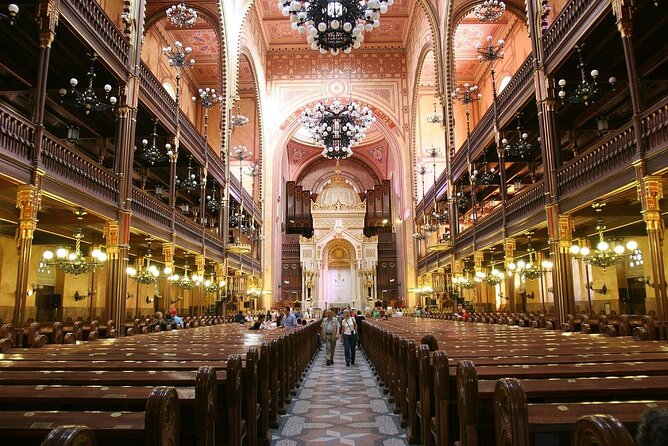
Next is Kazinczy Street Synagogue, an Orthodox synagogue in Budapest’s VII district. It was built between 1912 and 1913 in the Art Nouveau style, which is a fun curveball if you only expect older, more severe looking religious buildings. The architecture signals “this was a real, evolving community,” not a snapshot frozen in time.
The designers were Sándor Löffler and Béla Löffler. This synagogue was built for the Pest Orthodox Jewish Community, described here as the most tradition-bound of the three Jewish branches in Budapest at the time. That detail helps you read the building with more care. You are not only looking at style, you’re seeing how a particular community wanted to express itself.
Inside, the main prayer hall is a long, narrow space with a high barrel-vaulted ceiling. Walls are decorated with colorful stained glass windows, and the bimah, the Torah reading platform, is at the eastern end of the room.
World War II brought damage, but it was restored after the war. Today it functions as a working synagogue and is also a tourist attraction. That dual role matters. You’ll get the sense that sacred space can be both living and educational, and you should treat it accordingly with quiet, respectful attention.
More of Pest crossed at walking pace:



Stop 3: Rumbach Street Synagogue and Moorish Revival with Neolog traditions
Rumbach Street Synagogue, also called the Rumbach Synagogue, is another major stop in the same VII district. It was built between 1891 and 1892 in the Moorish Revival style, and it’s described as one of the largest synagogues in Europe. So yes, it’s impressive from the outside, but the interior layout does most of the storytelling.
The synagogue was designed by Komor & Jakab and built for the Neolog Jewish Community of Pest. Neolog Judaism is often associated with modernizing energy, and the building’s style reflects that confident, outward-facing design choice.
The main prayer hall is an octagonal space topped by a high dome. Instead of the stained glass look emphasized at Kazinczy, here you’ll focus on Moorish-style tiles covering the walls. The bimah sits at the center of the room, which changes the feeling of the space compared to the more linear layout you saw at Kazinczy.
As with the other synagogues, it was damaged during World War II and restored after the war. It is still a functioning synagogue, and it continues to draw visitors. On this tour, you’re seeing two different communities and two different architectural languages close together, which is exactly how you should compare them. One stop alone can blur the differences. Together, they sharpen your understanding.
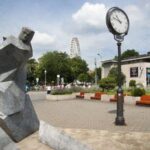
Stop 4: The Carl Lutz Memorial, the person who turned documents into protection
Carl Lutz Memorial takes the tour from buildings and layouts into one life-saving story. It commemorates a Swiss diplomat, Carl Lutz, who saved tens of thousands of Jews during the Holocaust.
The memorial is near the entrance to the former Budapest ghetto on Dob utca, so the emotional logic is clean. You start with the ghetto’s creation and the crowding. Then you move to a specific figure who helped people survive.
The centerpiece is a bronze sculpture by Tamás Szabó. It shows a dramatic scene: one figure reaches down from a building wall, connected by flowing cloth to another figure lying on the ground, representing a rescued Jew.
If you only remember one line from this stop, make it the inscription: Whoever saves a life is considered to have saved an entire world. It’s a moral framing that the guide will likely connect to how Lutz’s actions multiplied across many people.
The memorial’s significance is also spelled out. Lutz saved lives by issuing protective documents and creating safe houses during World War II. That matters because it shows resistance that was not only physical escape. It was also bureaucracy used for mercy, paperwork used as a shield.
Stop 5: Dohány Street Synagogue, the Great Synagogue of Budapest
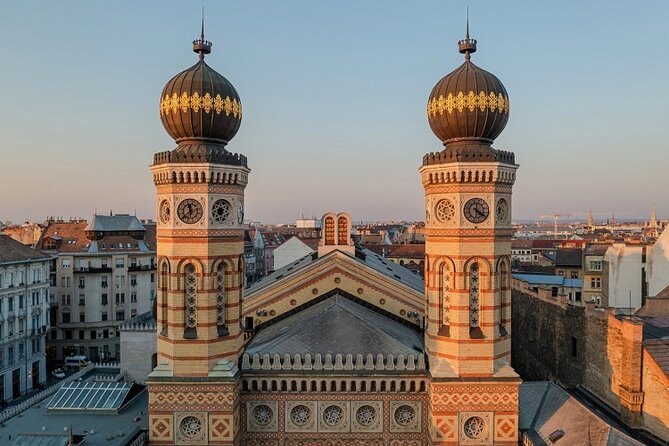
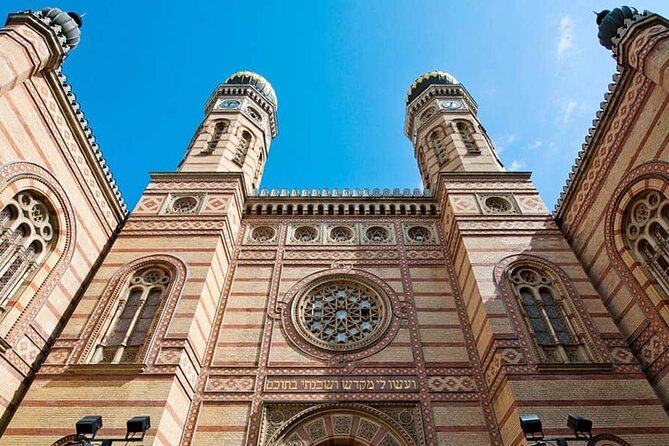
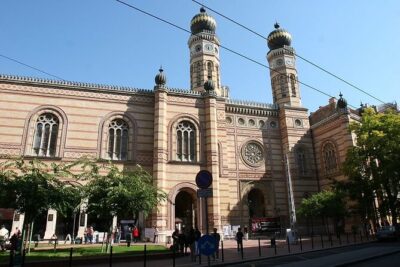
Now you come to the big one: Dohány Street Synagogue, also known as the Great Synagogue of Budapest. It’s the largest synagogue in Europe and the second largest in the world, located in the heart of the Jewish Quarter.
It was built between 1854 and 1859 in the Moorish Revival style. The architects were Austrian Ludwig Förster and Ignác Wechselmann, designed for the Pest Jewish Community. This stop is the “world-class” stop on the route, but you do not have to treat it like a showpiece only for photos.
The main prayer hall is a long, narrow space with a high barrel-vaulted ceiling. Walls are decorated with colorful stained glass windows, and the bimah is at the eastern end of the room, matching the pattern you saw at Kazinczy. That connection is a helpful detail. Even as architecture varies across different synagogues, there are recurring elements rooted in tradition.
World War II damaged the building, and it was restored after the war. Today it is functioning and a popular tourist attraction.
My practical advice here: look outward first, then let the guide walk you through what to notice inside. If you rush straight to the highlights, you can miss the layout details that make the architecture feel more meaningful than just pretty. With a guide, you can avoid that common mistake.
Stop 6: Shoes on the Danube Bank, why this memorial hits so hard
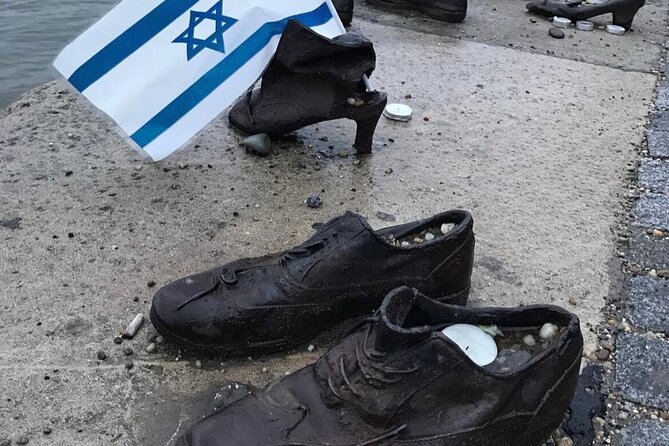
The final stop is Shoes on the Danube Bank, on the east bank of the Danube River. This memorial is made of 60 pairs of cast-iron shoes shaped to resemble styles worn in the 1940s, including men’s shoes, women’s shoes, and even children’s shoes.
They lie scattered along the riverbank like they were just taken off and left behind. It’s a simple idea, and that’s why it works. Your brain fills in the rest, and the guide helps you do it with accuracy, not guessing.
The tour explains the historical background: during World War II, thousands of Jews were murdered by the Arrow Cross Party, a fascist Hungarian group. Victims were often forced to remove their shoes at the edge of the Danube before being shot, and their bodies were dumped into the river. Shoes were valuable during wartime, so they were often stolen by executioners.
The memorial was installed in 2005 on the 60th anniversary of the Holocaust. It is a joint project by film director Can Togay and sculptor Gyula Pauer. That modern authorship can make it easier to approach. This is not some ancient artifact. It’s a deliberate choice to keep memory in the public eye.
Expect to slow down here. If you take nothing else from the tour, you will at least take this ending with you. It leaves a physical afterimage, which is rare for a walking tour.
The real value of a guide here, not just a checklist of stops
This is a tour where the guide quality matters a lot. The sites are powerful on their own, but the guided context is what helps you connect them into a coherent story.
I like the way your guide explains what you’re seeing at each stop, especially when architecture becomes history. At Kazinczy and Rumbach, the style details, community differences, and interior layout are the kind of information that can turn a quick glance into real understanding. When you hear what each synagogue was built for and how it was designed, you start noticing that the buildings are not just places of worship. They are also cultural statements.
And because it’s private, you can ask questions. That matters most on the memorial stops, where a lot of visitors end up with incomplete context. A good guide keeps the tone respectful and helps you avoid turning suffering into sightseeing.
The short on paper timing is also a feature. You get to cover major stops in about two hours, and then you can continue exploring the Jewish Quarter at your own speed with better mental bookmarks.
Price and practical value at $60.49 per person
At $60.49 per person, this tour sits in the midrange. It’s not a budget group free-for-all. It’s also not overpriced if you consider what’s included.
You pay for a tour guide, and the listed stops have admission tickets free. That means your money goes toward interpretation and pacing, not paying separate entrance fees.
Where this becomes a smart value is when you care about meaning. If your goal is to get a quick orientation and then move on, you might find it less worth it. But if you want clear explanations, especially around the ghetto timeline and the Holocaust memorials, the cost can feel justified quickly.
Also, the tour is booked about 91 days in advance on average. That’s a decent hint that people plan ahead for this specific route and that you will likely benefit from booking earlier rather than waiting until the last week.
Timing, weather, and what to wear for a comfortable Jewish Quarter walk
Plan around weather. The experience requires good weather, which makes sense when you’re going from memorial to memorial and along the Danube.
Wear comfortable walking shoes. Shoes on the Danube Bank is the kind of stop where you will naturally stand and look a bit longer, and the memorials around the ghetto area also reward slow reading.
Because it ends back at the start, you don’t need to plan a late complicated route home. You can finish, then either grab a meal nearby or continue strolling the Jewish Quarter with your new context.
If you’re traveling in a group, this tour’s private format can be particularly convenient. It gives you a shared experience without the friction of matching many strangers’ interests.
Should you book this Budapest Jewish Heritage walking tour?
I’d book this tour if you want a short, focused route that combines Holocaust-era remembrance with still-living Jewish culture. It’s a strong choice when you want a guide to connect names, dates, and physical landmarks into a story you can actually follow in real time.
I would skip or reconsider if you dislike walking, or if you’re visiting during weather that might cancel the tour. The duration is short, but the stops still require you to be present, not just pass by.
One last decision tip: if you already plan to see at least one major synagogue, this tour adds two more and finishes with a Danube memorial that almost everyone remembers for years. For $60.49 per person, that combination is a lot of structured meaning in two hours.
FAQ
How long is the Budapest Jewish Heritage walking tour?
It runs for about 2 hours.
What is the tour price per person?
The price is $60.49 per person.
Where does the tour start and end?
It starts at Starbucks FashionBudapest, Deák Ferenc u. 23, 1052 Hungary, and ends back at the same meeting point.
Is the tour private?
Yes. It is a private tour/activity, so only your group participates.
What language is the tour offered in?
The tour is offered in English.
Is a tour guide included?
Yes, a tour guide is included.
Do the stops require paid admission tickets?
The itinerary lists admission tickets as free for the stops included on the tour.
What if the weather is bad?
The experience requires good weather. If it is canceled due to poor weather, you will be offered a different date or a full refund.
FAQ
What is the cancellation policy?
Free cancellation is available up to 24 hours in advance for a full refund.
Centuries Stacked Along the Danube
- Budapest: Historic Cruise with Welcome Drink
★ 4.7 · 6,512 reviews - Budapest Historical Sightseeing – Free Walking Tour
★ 5.0 · 1,302 reviews - Buda Castle District Dark History, Legends and Vampire Night Tour
★ 4.5 · 1,240 reviews - BloodThirsty Hungary: Walking tour & Dark Historical Stories
★ 4.9 · 633 reviews
Newest from the Danube banks
- Gödöllö Royal Palace Privately with full board★ 5.0 · 1 review
- Private Budapest Tour with Thermal Bath or Market Visit★ 5.0 · 1 review
- Private Budapest walking tour – 4 hours★ 5.0 · 1 review
- Budapest Half Day Car Tour with Guide★ 5.0 · 1 review
- Budapest Private Transfer from Budapest city centre to Budapest Airport★ 3.0 · 1 review
- Magic Theme Team Adventure Game in the Streets of Budapest★ 5.0 · 1 review
- Budapest: Eat the Street, food tour with wine, 16+ tasting★ 5.0 · 1 review
- Private Transfer Budapest Airport BUD to Budapest by Car or Van★ 5.0 · 1 review
Jewish District Tours, compared.
Budapest Jewish Heritage Memorial Walking Tour & Synagogue Entry
Read our review →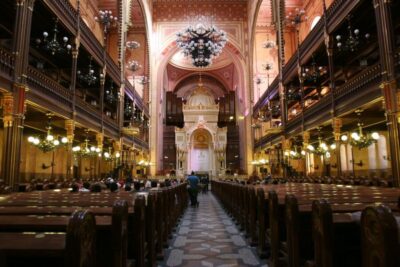
Budapest: Jewish Heritage Guided Tour with Synagogue Ticket
Read our review →
German tour in the Budapest city centre & the Jewish quarter
Read our review →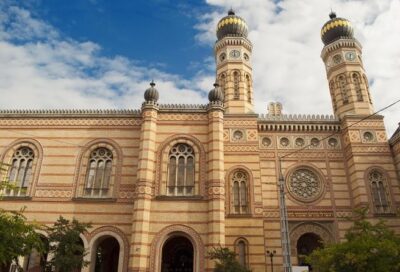
Past and Present of Budapest Jewish District Tour
Read our review →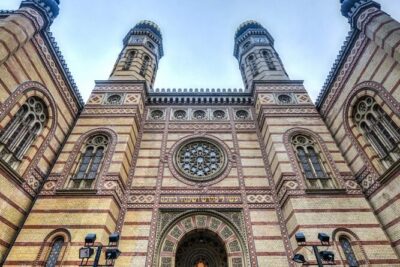
Budapest Dohany Synagogue & Hungarian Jewish Museum & free extras
Read our review →
Budapest: Jewish History Guided Walking Tour with Historian
Read our review →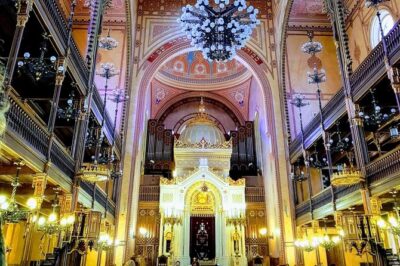
Budapest Dohany, Heroes’, Rumbach synagogues & Jewish Ghetto Tour
Read our review →Browse the lists this tour appears in